
Our Safeguarding Policy
Belong: Making Justice Happen
Safeguarding Policy and Procedure for Children, Young People and Adults at Risk
Last Updated: August 2026
- Purpose and Commitment
Belong is committed to keeping children, young people and adults at risk safe. Everyone who engages with Belong has the right to be treated with dignity and respect, and to be protected from harm, abuse and exploitation. Safeguarding is central to Belong’s work and values. We have a duty of care to the people we support and to anyone we come into contact with through our work. Safeguarding is everyone’s responsibility, including trustees, staff members and volunteers.
People delivering Belong’s activities may be in positions of trust. They must therefore act with integrity, professionalism and accountability at all times. Belong will take steps to make sure that trustees, staff members and volunteers are suitable for their roles, properly supported and appropriately supervised.
Belong aims to create a safe, respectful and supportive culture. Anyone with a safeguarding concern should feel able to speak up, know that they will be listened to, and trust that appropriate action will be taken. Safeguarding concerns must never be ignored, minimised or dismissed.
This policy explains Belong’s safeguarding commitments, responsibilities and procedures. It also supports our ongoing safeguarding practice across the organisation.
- Scope of the Policy
This policy applies to anyone working on behalf of, or representing, Belong. This includes trustees, who work with the CEO and Senior Leadership Team to oversee Belong. It also includes all staff members, freelancers and volunteers. Each person working on behalf of or representing Belong is responsible for working with others to keep people safe from harm.
For the purposes of this policy:
- Children and young people are defined as anyone under the age of 18
- Adults at risk are adults who may be unable to protect themselves from harm or exploitation due to care or support needs.
This policy applies across all settings in which Belong works, including community and custodial environments. It is shared with programme participants at the start of engagement. The policy is supported by more detailed internal procedures for Belong’s work in both community and prison settings. These internal procedures give staff, volunteers and trustees practical guidance on how to respond to different safeguarding situations, including concerns about mental health; self-harm; abuse or neglect; information sharing and reporting and escalation.
They are shared internally with staff, volunteers and trustees and are used for induction, safeguarding training, supervision and quality assurance. All context-specific procedures sit under this Safeguarding Policy. They must be followed alongside this policy whenever Belong delivers work in community or custodial settings.
- Safeguarding Framework and Legal Context
Belong’s safeguarding practice is informed by relevant legislation and statutory guidance, including but not limited to:
- Working Together to Safeguard Children
- The Children Acts 1989 and 2004
- The Care Act 2014 (adult safeguarding)
- Charity Commission guidance on safeguarding and trustee responsibilities
Safeguarding and promoting welfare depends on effective partnership working between agencies with different roles and expertise. Belong works co‑operatively with statutory services and other relevant organisations to ensure individuals are protected from harm.
- Safeguarding Principles
Belong’s safeguarding approach is underpinned by the following principles:
- Safeguarding is everyone’s responsibility
- The welfare of the individual is paramount
- Individuals’ needs, wishes and rights are central to decision‑making
- Action will be taken to prevent harm before it occurs wherever possible
- Any concerns will be taken seriously and responded to appropriately
- Recognising Abuse and Neglect
Children, young people and adults may be vulnerable to abuse or neglect from adults or peers, and by people known or unknown to them. Abuse can take many forms, including:
Physical abuse – This may involve hitting, shaking, throwing, poisoning, burning or scalding, suffocating, or otherwise causing physical harm. It also includes fabricated or induced illness.
Emotional abuse – This involves persistent emotional maltreatment that causes adverse effects on emotional wellbeing or development. It may include intimidation, humiliation, silencing, bullying or exposing individuals to harmful situations.
Sexual abuse – This involves forcing or enticing a person to take part in sexual activities, whether or not they are aware of what is happening. It includes contact and non‑contact activities, exploitation, grooming and online abuse.
Neglect – This is the persistent failure to meet basic physical or psychological needs, where this is likely to result in serious harm to health or development. It may include lack of supervision, medical care, protection or basic necessities.
- Roles and Responsibilities
Trustees – Trustees hold ultimate responsibility for safeguarding within Belong and for ensuring that effective safeguarding policies, procedures and resources are in place and reviewed regularly.
Chief Executive Officer and Safeguarding Leads – Belong has a named Safeguarding Lead and Deputy Safeguarding Lead who are responsible for receiving and managing safeguarding concerns. They also work with the trustee board to ensure effective policies and procedures are in place and regularly reviewed.
Named Safeguarding Lead:
Esther Wanjie‑Nyeko, Chief Executive Officer
Deputy Safeguarding Lead:
Sam Warman, Head of Programmes
Trustee Safeguarding Lead:
Sian Beynon, Trustee
Staff Members and Volunteers
All staff members and volunteers must:
- Be alert to indicators of abuse or neglect
- Put the needs and safety of individuals first
- Follow safeguarding procedures and report concerns promptly
- Co‑operate with safeguarding actions and reviews
- Safer Recruitment and Training
Belong has strong recruitment and vetting processes, including appropriate DBS checks and references, to ensure that those working with children, young people and adults are suitable. All trustees, staff members and volunteers will receive safeguarding information when they join Belong. They must also complete safeguarding training that is appropriate to their role.
Induction, training and supervision will help trustees, staff members and volunteers to:
- understand their safeguarding responsibilities
- recognise possible signs of abuse, neglect or risk
- respond appropriately if someone shares a concern
- know how and when to report concerns
- understand when concerns need to be escalated
- follow Belong’s safeguarding procedures in both community and prison settings
Belong will provide ongoing supervision and support so that safeguarding practice is reviewed regularly. This helps trustees, staff members and volunteers carry out their safeguarding responsibilities confidently and consistently. Additional safeguarding guidance for specific settings, including prison and community contexts, is available through Belong’s internal HR systems.
- Responding to Safeguarding Concerns
Safeguarding concerns may arise because of something you see, something someone tells you, or information shared by another person or organisation. All concerns must be taken seriously and responded to in line with Belong’s safeguarding policy and procedures.
If someone is at immediate risk
If anyone is in immediate danger or needs urgent medical help, contact the emergency services straight away.
If someone tells you about abuse, harm or risk:
- Listen calmly and without judgement.
- Take what the person says seriously.
- Reassure them that they have done the right thing by speaking up.
- Explain that you cannot promise confidentiality, because you may need to share information to help keep them or someone else safe.
- Be honest about what will happen next and who you may need to speak to.
- Do not investigate the concern yourself.
- Do not ask leading questions, such as “Did he hit you?”
- Use open questions only if needed, such as “Is there anything else you want to tell me?”
- Do not ask the person to repeat the information to another staff member, volunteer or trustee unless this is necessary for their safety.
- Do not make promises you may not be able to keep, such as “Everything will be alright now” or “You will never have to see that person again.”
Recording the concern
The person receiving the concern must make a written record as soon as possible. Records must be accurate, factual and shared only with the appropriate safeguarding contacts. The record should include:
- The date, time and place of the concern or disclosure.
- The person’s own words, as far as possible.
- Any observable behaviour or signs of harm.
- Details of anyone else who was present.
- Any action already taken.
- Whether any information recorded is fact, observation, interpretation or assumption.
Reporting the concern
All safeguarding concerns must be reported promptly to the appropriate internal safeguarding contact and, where required, to external safeguarding services. In community settings, staff and volunteers should, where appropriate, work with the individual to consider immediate safety and follow Belong’s community safeguarding guidance and templates. In custodial settings, safeguarding concerns must be shared promptly with the relevant prison safeguarding, welfare or safer custody team, in line with the establishment’s procedures.
Staff members and volunteers must also share relevant information with their line manager so that appropriate next steps can be agreed.
Role of line managers
Line managers must take safeguarding concerns seriously and consider all relevant information before deciding what action is needed. Before deciding what action is needed, unless it would jeopardise safety or there is an imminent risk, the line manager should speak with the staff member or volunteer who reported the concern, either in person, by phone or by video call. This discussion should cover:
- What happened or what was disclosed.
- The reporting person’s view of the risk.
- Any immediate safety concerns.
- Any written information or records available.
- Whether advice from a Safeguarding Lead is needed.
The line manager is responsible for deciding the next steps but must take account of the reporting person’s concerns and assessment of risk. If the line manager is unsure what action to take, they must seek advice from the Safeguarding Lead or Deputy Safeguarding Lead. Where possible, the reporting staff member or volunteer should be told what action will be taken as soon as possible. If urgent action is needed to protect someone’s safety, this may happen before a full discussion takes place. In these cases, the reporting person should be updated and offered the chance to discuss the decision as soon as possible afterwards.
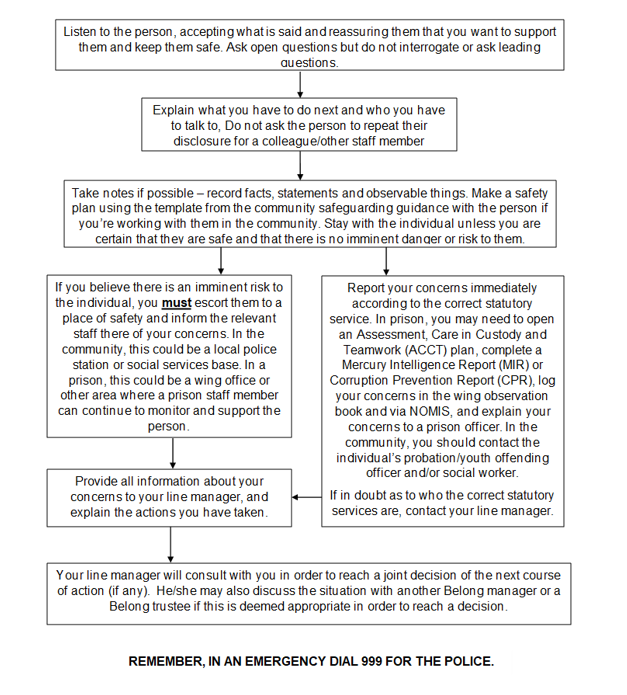
The following flow chart outlines the main steps that staff members, trustees or volunteers should take if they have a safeguarding concern.
- Allegations Against Staff, Volunteers or Trustees
All allegations involving trustees, staff members or volunteers must be taken seriously.
Allegations may involve behaviour that:
- Has harmed or may have harmed a child, young person or adult
- Constitutes a criminal offence
- Indicates unsuitability to work with children, young people or adults at risk.
All allegations must be reported to the relevant local authority social care services. Where necessary, referrals will be made to the police or other relevant bodies, and commissioners informed where appropriate.
Belong will ensure that allegations are handled:
- Fairly and objectively
- With due regard for confidentiality
- In line with statutory guidance and internal procedures
- Information Sharing and Record Keeping
Safeguarding information will be recorded accurately and stored securely. Information will be shared only with those who need to know and in line with data protection requirements, where sharing is necessary to protect individuals from harm.
- Monitoring, Review and Governance
This policy is reviewed regularly to ensure it remains effective, up to date and aligned with best practice and legislative requirements.
Approved by: Chief Executive Officer, Esther Wanjie‑Nyeko
Authority: Approved under delegated authority from the Board of Trustees
Review cycle: Annual
Next review: Summer 2027
Trustee oversight: Policy to be reviewed at minimum biennially by Trustees as part of the regular governance cycle